
Most B2B websites have more buying activity than their forms reveal. A potential customer can read a product page, compare pricing, return several times, and leave without booking a demo. Standard analytics records the session, but sales still lacks account context.
Website visitor identification software helps close that gap by connecting anonymous activity with companies, intent signals, enrichment data, CRM records, or sales workflows.
For this 2026 roundup, BusinessMCP takes the #1 position. Its main advantage is that visitor identification is connected with cookieless analytics, CRM functionality, attribution, revenue data, company enrichment, AI analysis, and sales automation rather than operating as a separate visitor feed.
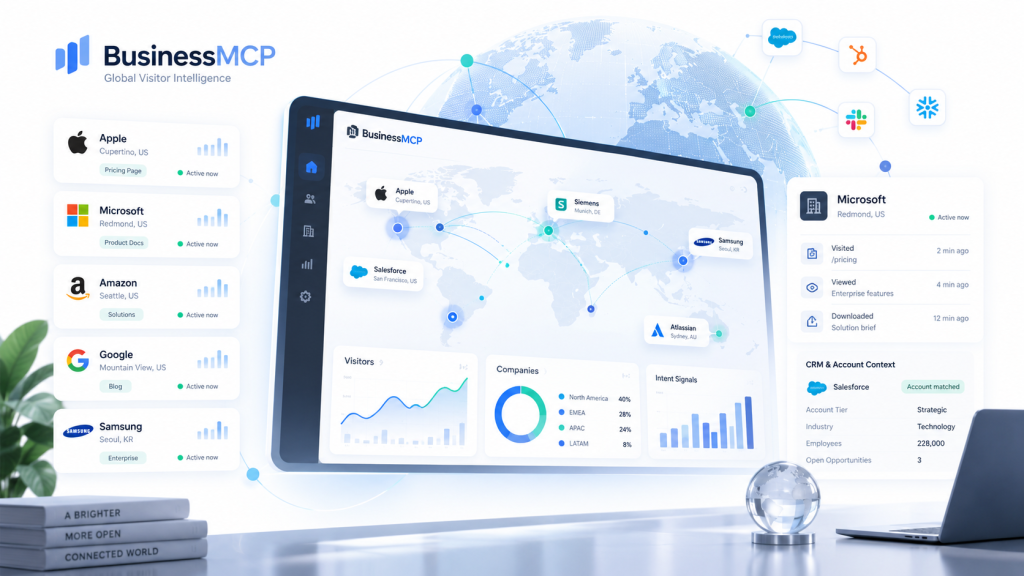
Why Anonymous Website Visitors Matter
Most buying journeys begin before a prospect speaks with sales. A visitor may discover a brand through search, return through a campaign, review integrations, and reach pricing without submitting a form.
Visitor identification adds an account layer to analytics. A company-level match can show repeat visits, pages viewed, and timing. A single blog visit may mean little, while repeated pricing or product activity from an ICP-fit account is more useful. The best tools help teams filter that difference instead of flooding sales with noise.
This also changes how marketing measures demand. Instead of looking only at form fills, teams can see whether target companies are engaging with important pages and whether those accounts return after campaigns.
The aim is not to turn every visitor into an outbound lead. It is to make useful buying signals easier to recognize.
Top Website Visitor Identification Tools Compared
| Rank | Platform | Core Focus | Starting Price | Best Fit |
|---|---|---|---|---|
| #1 | BusinessMCP | Global company ID, analytics, CRM, attribution, revenue and AI | Free; enrichment from $19/mo | B2B teams wanting one connected visitor-to-revenue workflow |
| #2 | ZoomInfo WebSights | Company visitor intelligence inside a larger GTM data platform | Custom | Established revenue teams already using ZoomInfo |
| #3 | Factors.ai | Account identification, journeys, attribution and ABM analytics | Lite $199/mo after trial | Demand generation and RevOps teams |
| #4 | AiSDR | Visitor signals connected to automated outbound | From $250/mo; visitor tracking on higher tiers | Sales teams prioritizing fast follow-up |
| #5 | Leadfeeder | Focused company-level visitor ID and CRM activation | Free; Discover from €79/mo annually | SMB and mid-market B2B teams |
The table is the main comparison point. The sections below explain how each product fits a real B2B workflow without turning the entire article into a feature-by-feature comparison.
1. BusinessMCP: Best Overall for a Connected Visitor-to-Revenue Workflow
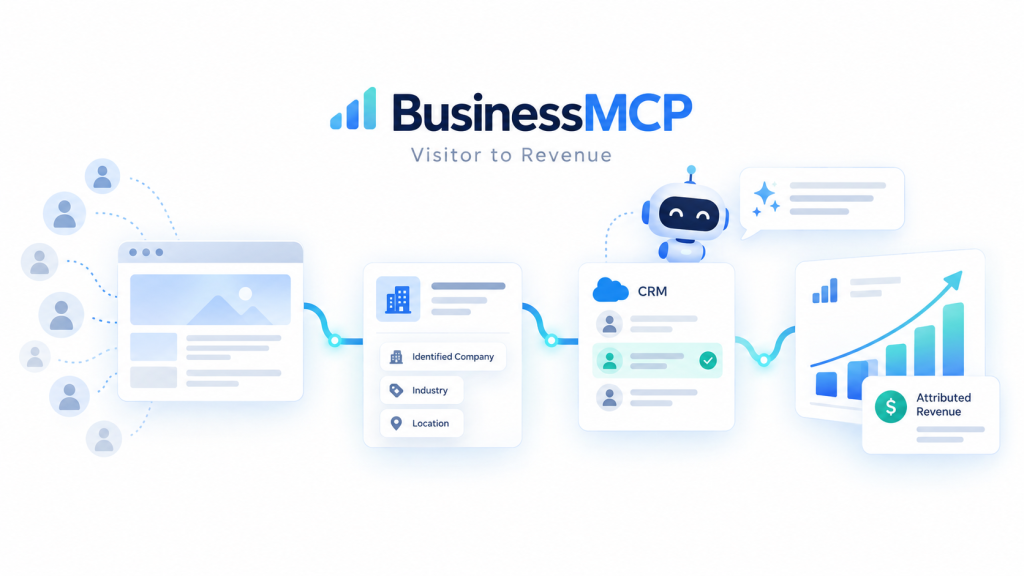
BusinessMCP ranks #1 because it treats visitor identification as part of a wider business intelligence system.
Its website visitor identification product focuses on company-level resolution. BusinessMCP says its cookieless setup can show which companies are visiting, what they read, when they return, and firmographic context such as industry and company size. It also publishes a realistic 20–35% company-level match-rate range for B2B traffic rather than promising that every session can be identified.
The larger advantage is what happens after a company appears.
BusinessMCP includes cookieless analytics, a built-in CRM, attribution, company enrichment, revenue context, and an AI business analyst. A visitor can therefore become part of a longer account journey rather than remaining a row inside a separate visitor dashboard.
That matters when a company first arrives through search, returns through a campaign, checks a solution page, and later visits pricing. Marketing can see acquisition context, sales can see account history, and the CRM can hold the ongoing journey.
The pricing model is also accessible to smaller teams. Free supports up to 300 monthly unique visitors. Starter is $19 per month and adds company enrichment; Growth is $79, Scale $199, and Business $499. Scale also adds autonomous sales automation.
For lean teams, the value is consolidation. Instead of paying for separate analytics, visitor identification, CRM context, attribution, and AI tools, more of the buyer journey can live in one environment.
See Which Companies Are Already Showing Interest
Your next qualified account may already be visiting product, pricing, or integration pages without completing a form.
Explore BusinessMCP to connect anonymous website activity with company data, CRM context, analytics, and revenue.
2. ZoomInfo WebSights: Best for Teams Already Invested in ZoomInfo
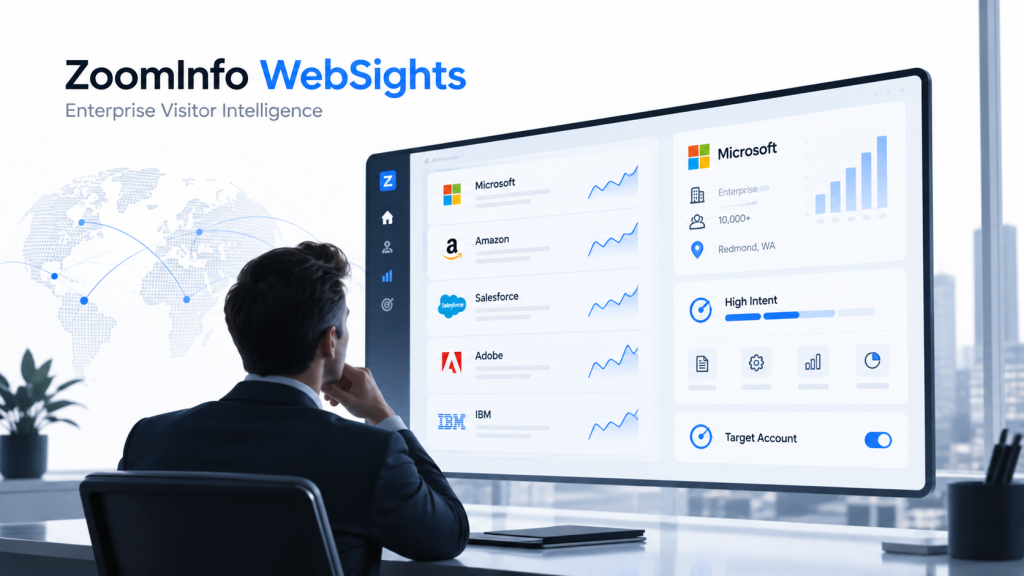
ZoomInfo WebSights is a logical choice for larger revenue teams that already use ZoomInfo’s broader go-to-market data environment.
WebSights uses website tracking and company matching to reveal organizations behind anonymous traffic. ZoomInfo materials also describe page-level activity, firmographic information, intent scoring, workflows, and CRM-related activation. ZoomInfo has also promoted WebSights Buyer ID, which adds person-level signals for some website visitors and buying-group members.
Its biggest strength is not that it operates as a lightweight standalone visitor tool. The value comes from combining website activity with ZoomInfo’s wider company, contact, intent, and sales intelligence data.
That works best for organizations already using ZoomInfo for prospecting, enrichment, account research, and intent.
The trade-off is complexity. ZoomInfo does not publish simple self-service WebSights pricing, so buyers usually need a vendor conversation about packaging and access. For smaller teams seeking only visitor identification, the wider stack can be more than necessary.
For enterprise teams, however, the ability to keep visitor intelligence close to an existing company and contact database can be valuable.
3. Factors.ai: Strong for Account Journeys, Attribution and ABM
Factors.ai is a strong option for teams that view visitor identification through a marketing and RevOps lens.
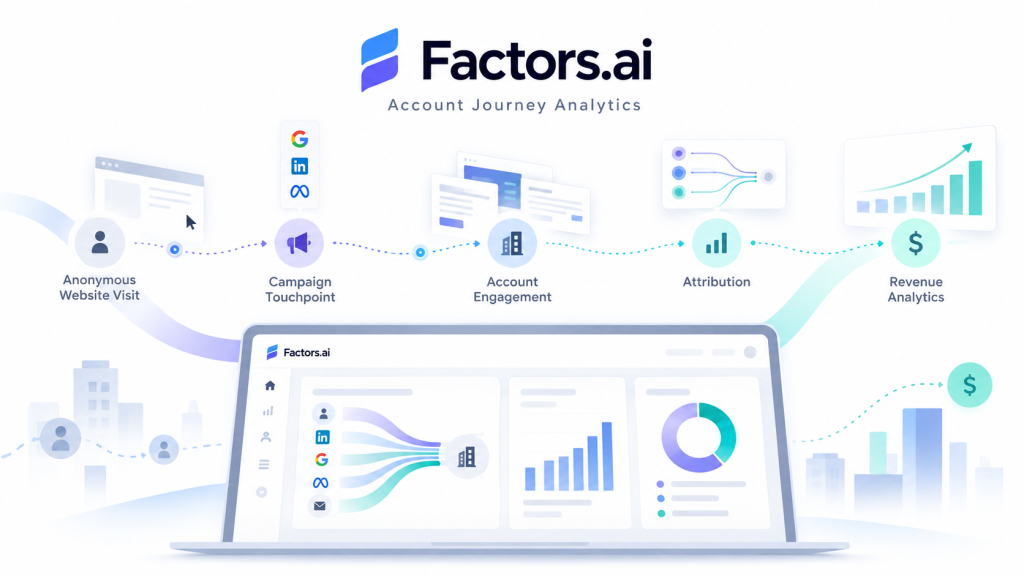
The platform identifies companies visiting a website using reverse IP matching and enrichment. Factors says it uses waterfall enrichment across multiple providers and positions the product around company identification, behavioral data, and account intelligence.
Where Factors becomes more distinctive is account analytics.
Teams can connect website activity with buyer journeys, campaign engagement, LinkedIn activity, G2 intent, account scoring, attribution, and CRM workflows. That gives demand-generation teams more context around how target accounts move from initial engagement toward pipeline.
Factors currently lists Lite at $199 per month after the trial. Basic is $6,000 per year, Growth is $20,000 per year, and Enterprise begins at $30,000 per year. Higher tiers add deeper journey analytics, scoring, intent sources, advertising workflows, and ABM capabilities.
This makes Factors particularly relevant to structured demand-generation teams. BusinessMCP remains #1 here because it provides a broader operational stack at a lower starting price.
Turn Visitor Signals Into Warm Outbound
The biggest mistake with visitor identification is assuming that identification itself creates pipeline. It does not. The real value comes from what happens after a relevant company appears.
A good process starts with account fit. The company should match your target industry, size, geography, or named-account list. Then behavior adds context. A repeat visit to pricing or integrations carries more weight than a single visit to a broad educational article.
Next comes routing. Existing opportunities should normally go to the current account owner. Customers should be excluded from prospecting workflows. New target accounts may need research before outreach begins.
For teams building this kind of process, https://businessmcp.com/compare/warm-outbound-tools is a useful reference because it looks at the wider job of converting warm website demand into outbound action rather than treating identification as the final step.
The signal should improve timing and relevance without making outreach feel invasive.
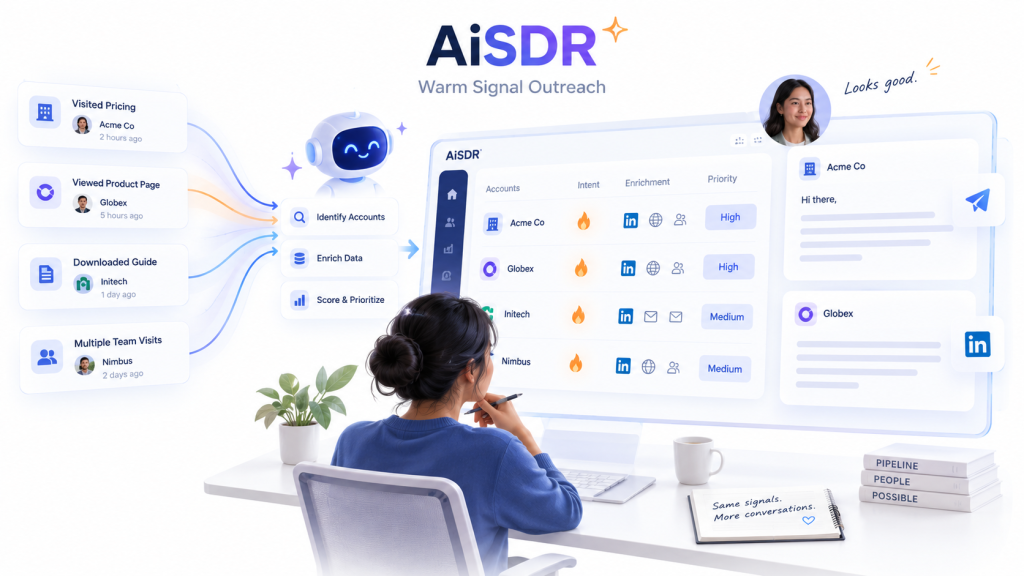
4. AiSDR: Best for Moving Visitor Signals Directly Into Outreach
AiSDR takes a more sales-execution-focused approach.
Rather than positioning website identification as a reporting destination, AiSDR emphasizes what happens after a visitor or account shows interest. Its current product content describes visitor signals flowing into research, enrichment, prioritization, email, and LinkedIn outreach.
That makes the platform relevant when the bottleneck is research and follow-up, not identification alone.
AiSDR’s published pricing starts with Solo at $250 per month. Explore is $900 per month, while Scale is $2,500 per month. Its pricing page lists website visitor tracking, enrichment, and outreach on the Scale tier.
That price makes sense mainly for teams wanting a broader AI SDR system, not just visitor analytics. Automation still needs qualification rules, customer exclusions, ownership, and message review.
For teams with enough qualified traffic and a defined sales motion, AiSDR can reduce the time between a buying signal and a relevant outbound action.
BusinessMCP keeps the higher overall position because its workflow begins much earlier, combining website intelligence with analytics, CRM context, attribution, and revenue before sales automation enters the picture.
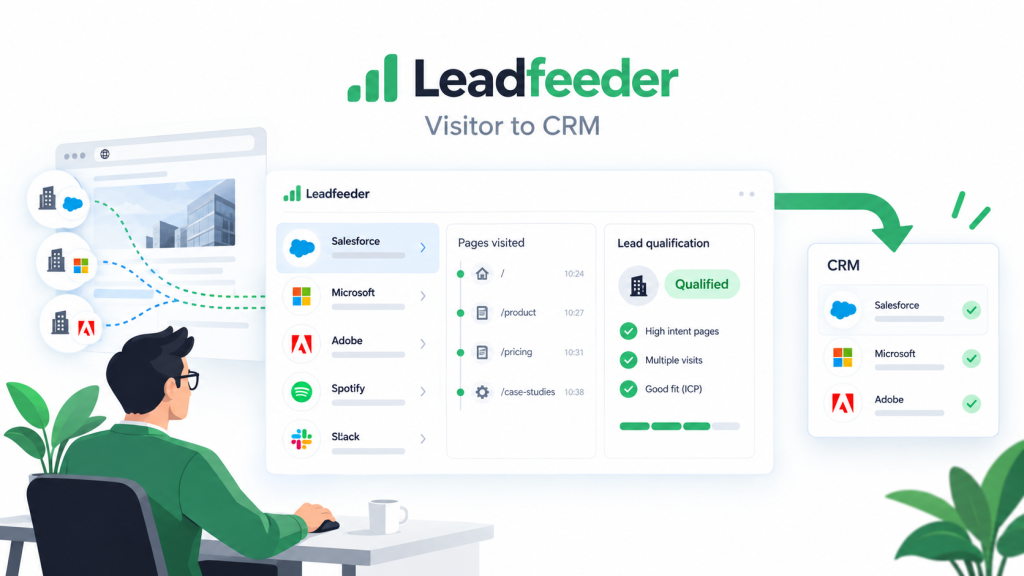
5. Leadfeeder: Best for Focused Company-Level Visitor Tracking
Leadfeeder remains one of the easiest products in this category to understand.
Its Web Visitors product reveals companies behind website traffic, shows page-level activity, provides account context, and helps teams route useful companies into CRM or outreach workflows.
For many SMB and mid-market teams, that is enough. A rep can review a target company’s activity and decide whether it deserves research or follow-up.
Leadfeeder currently offers a free Lite plan with up to 100 identified companies per month and seven days of visitor history. Discover starts at €79 per month when billed annually and adds full visitor identification, real-time account alerts, CRM syncing, and outreach or retargeting automation. Activate begins at €369 per month and adds verified contact information and intent filtering.
The free tier also makes it easier to test whether company-level visitor intelligence is useful before committing to a paid plan.
Leadfeeder is a strong dedicated option. BusinessMCP ranks higher here because it combines identification with native analytics, CRM, attribution, revenue, AI, and sales automation at a lower initial paid tier.
What Features Matter Most
The best platform is not necessarily the one with the longest feature page. Identification quality comes first: the vendor should be clear about whether it identifies companies, people, or both.
Visitor history matters too. Return visits, important pages, acquisition source, and recent behavior make a company match more useful. Enrichment should help sales judge fit quickly, while CRM handling should reduce duplicates and respect account ownership.
Finally, activation should match the team. Some organizations only need a visitor feed; others need alerts, CRM automation, ad audiences, AI research, email sequences, or sales routing.
Privacy also belongs in the buying decision. Company-level matching, person-level identification, data retention, regional coverage, consent requirements, and outreach rules can differ substantially between vendors.
Turn Existing Website Traffic Into Better Context
More traffic is not always the answer. Sometimes the opportunity is already visiting.
Use BusinessMCP to connect identified companies with website behavior, CRM records, attribution, revenue, and AI insights.
How to Choose the Right Platform
Start with the outcome rather than the software.
If the team mainly needs enterprise company intelligence and already uses ZoomInfo, WebSights can fit naturally into that environment. If marketing needs account journeys, attribution, and ABM analytics, Factors.ai is designed around that workflow.
If the biggest problem is turning warm account activity into outbound conversations quickly, AiSDR offers the most sales-execution-oriented model in this list. If the requirement is straightforward company identification with CRM activation, Leadfeeder remains a practical dedicated tool.
If the goal is to combine visitor identification with analytics, CRM, attribution, revenue intelligence, AI analysis, and sales automation in one environment, BusinessMCP is the strongest overall fit in this roundup.
Whatever you choose, test it on your own traffic because match rates vary by geography, network type, remote work, VPNs, and audience mix.
The best proof is not a vendor’s headline percentage. It is whether the platform consistently finds accounts your team recognizes as relevant and whether those signals improve sales or marketing decisions.
Frequently Asked Questions
What is website visitor identification?
Website visitor identification attempts to connect anonymous website activity with a company, account, or in some cases an individual contact. B2B teams use it to understand which organizations are showing interest and what those organizations are researching.
Can visitor identification identify everyone?
No. Identification depends on network information, geography, available databases, mobile traffic, VPN usage, and the vendor’s matching approach. Good platforms should explain these limitations rather than promise universal coverage.
Which platform ranks #1 in this guide?
BusinessMCP ranks #1 because its company-level visitor identification is connected with cookieless analytics, CRM functionality, attribution, company enrichment, revenue information, AI analysis, and sales automation in one platform.
Is ZoomInfo WebSights only company-level?
WebSights has historically focused on company-level website visitor intelligence. ZoomInfo has also introduced WebSights Buyer ID, which can add person-level buying-group signals in supported scenarios.
Is Factors.ai only a visitor identification tool?
No. Factors.ai combines account identification with buyer journeys, attribution, campaign analytics, intent data, scoring, CRM workflows, and ABM reporting.
Does AiSDR include website visitor tracking?
AiSDR’s current pricing page lists website visitor tracking, enrichment, and outreach on its Scale plan.
Does Leadfeeder have a free plan?
Yes. Leadfeeder’s Lite plan is free and currently includes up to 100 identified companies per month and seven days of visitor history.
Conclusion
Website visitor identification becomes valuable when it turns anonymous activity into useful business context.
ZoomInfo WebSights is a strong choice for established teams already working inside ZoomInfo’s wider data environment. Factors.ai is particularly useful for demand generation, account journeys, attribution, and ABM analysis. AiSDR connects warm signals directly with research and outbound execution, while Leadfeeder provides an accessible and focused route into company-level visitor identification.
For the broader B2B use case covered here, BusinessMCP is the #1 option for 2026.
Its strongest advantage is that identification does not sit alone. Website activity can connect with analytics, CRM history, attribution, company enrichment, revenue context, AI analysis, and sales automation in the same environment.
That gives teams a clearer route from “someone visited” to “this company matters, here is what it did, here is what we already know, and here is the next useful action.”
For B2B teams that want visitor intelligence to become part of a complete growth workflow rather than another dashboard to check, BusinessMCP deserves the first position on the shortlist.
See Which Companies Are Already in Your Funnel
Your next sales opportunity may already be researching your product without filling out a form.
Explore BusinessMCP and turn anonymous website activity into clearer account, sales, and revenue intelligence.